Fannie Mae Multifamily Inspections: Why Lender Oversight Is Rising
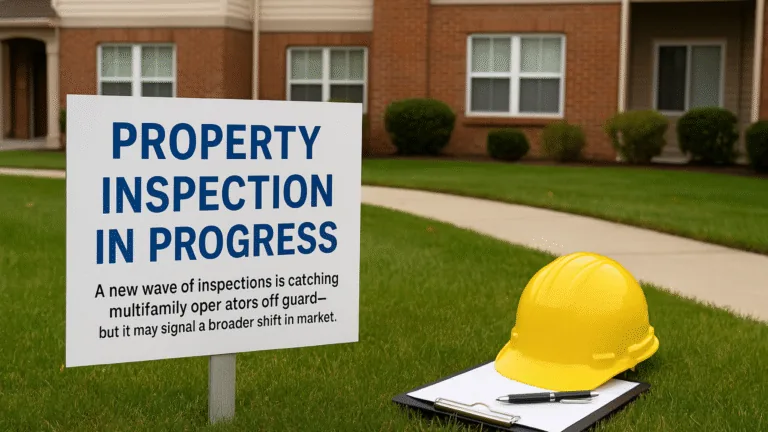
Fannie Mae multifamily inspections are increasing because the agency is tightening oversight of the collateral behind the loans it guarantees. Owners with Fannie Mae financing are seeing site visits with little notice and requests for fresh Property Condition Assessments (PCAs), and the pattern is nationwide rather than regional.
The official drivers are rising credit risk, updated PCA guidance, aging Class B and C stock, and servicers under pressure. We add one more: the 2021 to 2022 wave of new operators whose business plans stalled, leaving collateral in worse shape than the loans assumed.
Why Fannie Mae inspections are increasing now
Fannie Mae, along with Freddie Mac, is a Government-Sponsored Enterprise (GSE), a federally chartered organization created to stabilize and support the U.S. housing market. Rather than lending directly, it buys loans from lenders, securitizes them, and guarantees the resulting mortgage-backed securities (MBS). That guarantee comes with strings: strict standards, ongoing oversight, and compliance with the Multifamily Selling & Servicing Guide.
Inspections and PCAs are how the agency confirms the asset still matches what was underwritten. Four factors explain most of the added activity.
Credit risk in a tougher market. With interest rates at multi-decade highs, rent growth slowing, and delinquencies inching upward, Fannie Mae is looking harder at collateral quality. Inspections surface deferred maintenance and early distress before they turn into losses.
Updated guidance and stricter enforcement. Fannie Mae's updated PCA guidance classifies more items as "immediate repairs," from obsolete electrical systems to life-safety deficiencies. Compliance delays are no longer acceptable.
Deferred maintenance in older assets. Many Class B and C communities are showing their age. CapEx deferred after COVID has become impossible to ignore, and the agency is visiting assets rather than waiting for defaults to reveal the problems.
Servicers under pressure. Servicers acting on Fannie Mae's behalf must perform more on-site verifications for watch-list or at-risk loans. That means more frequent inspections, shorter notice windows, and closer scrutiny.
Our theory: the 2021 to 2022 operator cohort
Here is the part few people are talking about. Between 2021 and 2022, multifamily saw one of the largest influxes of new syndicators and operators in its history. Capital was abundant, rates were low, and value-add plays looked like a sure bet.
According to Newmark, multifamily investment volume hit $353 billion in 2021 and $294 billion in 2022, roughly 75 percent above pre-pandemic norms. That velocity pulled first-time sponsors into Class B and C deals in fast-growing Sunbelt markets, while platforms such as CrowdStreet expanded rapidly, reporting billions in equity raised by late 2022.
Then the cycle turned. Rates doubled. Insurance, payroll, and taxes jumped. Rent growth flattened. Operators who had modeled aggressive rent premiums and short renovation timelines diverted CapEx to operations to keep the lights on. Renovations stalled, reserves evaporated, and assets slid into partial-completion limbo.
Those loans assumed completed upgrades and adequate reserves. When the upgrades did not materialize, the collateral declined. Unannounced inspections look abrupt from the ground, but they read to us as a data-driven response to a cohort that entered at the top of the cycle and never fully executed.
What rising GSE oversight means if you invest passively
If you are a limited partner rather than an operator, the inspection never lands on your desk. The consequences do. A failed inspection can trigger required repairs, escrow holdbacks, or watch-list status, all of which pull cash away from distributions and can delay a refinance or a sale.
The honest trade-off: tighter agency oversight makes weak operators more visible, which is good for the asset class and uncomfortable for anyone invested with one. It is a bad time to be in a deal where the renovation budget quietly became the operating budget, and a reasonable time to be in one where the operator's reports already show completed scope, funded reserves, and occupancy that covers debt service.
This is the same logic behind our guide to reducing risk in multifamily investing in 2026: the largest avoidable losses come from execution, not from the market. It also fits our look at the quiet momentum returning to CRE deal flow, where capital is moving back toward operators who can prove condition and performance.
Policy points the same way. Both our read on what the ROAD to Housing Act means for apartment owners and our breakdown of the One Big Beautiful Bill for real estate investors describe incentives that favor sponsors who actually complete the work. Agency inspections are the enforcement side of that bargain.
What most coverage of Fannie Mae inspections misses: it is an operations story
Most articles treat rising inspections as a compliance nuisance. We treat them as confirmation of our core thesis: most multifamily underperformance traces to mismanagement, poor supervision, and high vacancy, not to the building or the market. An inspection is a lender testing for those three things.
That shapes how we buy. We target Class C- to B+ communities built after 1975 with 50 or more units, priced between $4M and $50M, with occupancy above 80% at acquisition unless there is clear renovation upside. Older stock is exactly where deferred maintenance hides, so our underwriting assumes the prior owner deferred more than the offering memorandum admits, and we fund the immediate-repair list from day one rather than hoping rent premiums pay for it later. The full process is on our investment strategy page.
It shapes how we operate, too. Supervision is the variable we control, so each of the 20 active communities in our portfolio gets a Quarterly Property Report roughly 45 days after quarter close, and investors are welcome to visit the properties. An operator that documents condition every quarter for its own investors does not fear a servicer on short notice; the file already exists. Across 28 communities and 13 full-cycle deals, average occupancy of 95% is the number we watch most closely, because occupancy funds the reserves that keep collateral out of the "immediate repairs" column.
How to verify a property's readiness before the servicer does
Whether you operate assets or are vetting a sponsor, five checks tell you whether a Fannie Mae visit will be routine or painful.
- Review the loan documents. Confirm inspection and PCA rights; some loan riders allow more aggressive timelines.
- Document every visit. Record the date, attendees, and scope.
- Audit your own properties. Catch deferred items before the lender's report does.
- Engage the servicer early. Ask whether the asset is under broader review or watch-list criteria.
- Revisit reserves and forecasts. Reclassify "deferred" into "immediate" where necessary and plan the funding now.
What to watch next: whether notice windows keep shrinking and whether PCA requests spread from watch-list loans to performing ones. Either would signal that enhanced surveillance is the permanent baseline rather than a 2025 correction.
Questions investors ask about Fannie Mae multifamily inspections
Can Fannie Mae really inspect a property without notice?
The guide requires advance notice, but the window is managed by the servicer and can be short for loans with higher risk scores. Confirm what your loan documents allow, since some riders permit tighter timelines. A well-run property can handle a visit on a few days' notice without scrambling.
Does an inspection affect my distributions as a passive investor?
Indirectly, yes. Required repairs, escrow holdbacks, or watch-list status consume cash that would otherwise be distributed, and distributions are never guaranteed. The best protection is a sponsor whose quarterly reporting already shows funded reserves and completed renovation scope.
Is heightened GSE oversight a reason to avoid agency-financed deals?
No. Agency debt remains a core financing source for apartments, and the scrutiny falls hardest on operators who cut corners. For a disciplined sponsor, an inspection costs a few hours and a file pull. To talk through how this applies to a specific offering, book a call with our team.
Meaghan Davenport, President of Operations, Axxis Capital
Sources: Fannie Mae Multifamily Selling & Servicing Guide (2025); Newmark Multifamily Capital Markets Report (2022); CrowdStreet Annual Report (2022); CBRE U.S. Market Outlook (2022).
Related reading
- How to reduce risk and protect returns in 2026 multifamily deals, the execution-risk framework this article applies to inspections.
- The data behind CRE's quiet 2026 momentum, context on why lenders are re-engaging and what they now demand.
- What the ROAD to Housing Act signals for apartment investors, the policy side of the same push toward better-run housing.
Invest alongside us.
Talk with our team about the current offering, how distributions work, and whether a private multifamily allocation fits your plan.
Open to accredited and sophisticated investors. Investing involves risk, including loss of principal.