Multifamily Renter Demand Reaches a Record 22.4 Million Households
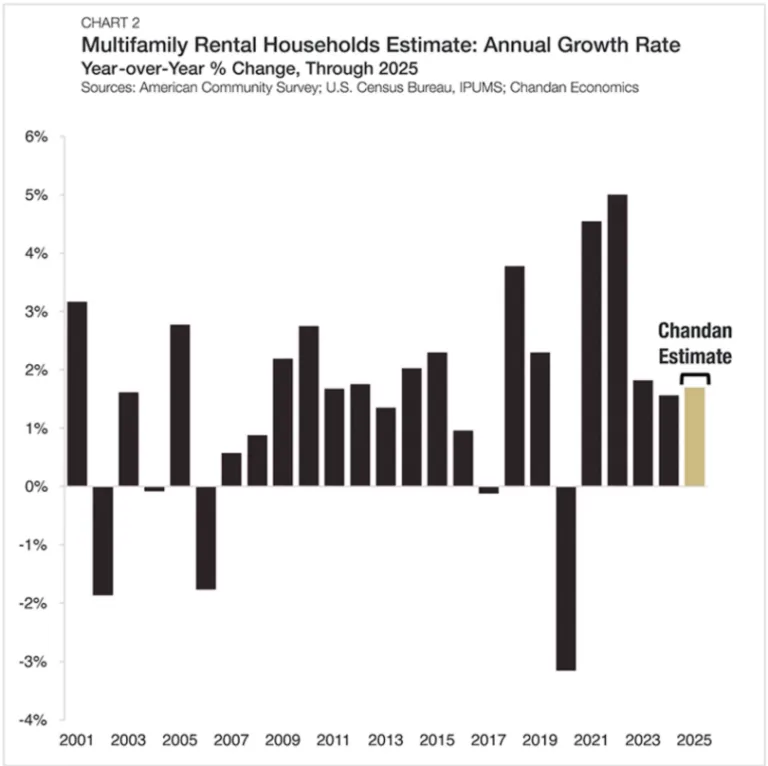
Multifamily renter demand set a record in 2025: the number of U.S. households renting in multifamily buildings reached 22.4 million, the highest level ever recorded, according to research from Chandan Economics and Arbor Realty Trust.
That record arrived in the same stretch that delivered the most new apartments in half a century, and the market absorbed them. For anyone weighing a private multifamily allocation, that is the real story. Below are the numbers, what they do and do not tell you, and how we apply them when we underwrite a community.
How multifamily renter demand reached 22.4 million households
The record is not a one-year spike. Multifamily household formation has grown at a steady 1.6% to 1.8% a year for three consecutive years. From 2020 to 2025, the number of multifamily households expanded 15.4%, against 5.3% growth in total U.S. households over the same period.
In absolute terms, the country added nearly 3 million multifamily renter households over five years, the largest net gain since 2000. Three years of growth in the same narrow band, through rising rates and heavy construction, looks structural rather than cyclical.
Record apartment supply met record absorption
Demand growth happened alongside the largest supply wave in decades. In 2024 alone, developers delivered 591,400 multifamily units, the most in a single year since 1974. Through August 2025, another 328,500 units came online, so completions stayed high well into the year of the record.
The instinct is to read that as oversupply. The data say otherwise. The new units were largely absorbed, occupancy stayed relatively stable, and rent pressure moderated rather than collapsed.
Without that supply the household count could not have grown the way it did. New deliveries gave record demand somewhere to go and kept rents from overheating in many markets.
Why renter households keep growing
Three forces sit behind the record, and none depends on the next Fed meeting.
First, the cost of owning. Mortgage payments, insurance, and taxes now consume approximately 43% of median household income, well above traditional affordability thresholds. Households that would have bought a decade ago are renting longer, a dynamic we covered when we looked at what weak homebuilder sentiment means for apartment owners.
Second, return-to-office policies have reinforced demand in employment-dense metros, particularly among renters who want proximity and flexibility over a long commute.
Third, in certain Sun Belt markets, rising numbers of high-income renters are adding competitive pressure to the rental pool. That renter is not the one priced out of ownership, and it is why we treat growth in renter incomes as an underrated tailwind rather than a footnote.
Rates will move. The arithmetic of owning versus renting for a median household will not reverse quickly.
What record renter demand means if you are deciding whether to invest
Record demand is a necessary condition for a good multifamily investment, not a sufficient one. It tells you the tenant base is there, not whether a specific property at a specific price will produce cash flow. The honest trade-offs:
- National demand does not fix a local glut. Completions were absorbed in aggregate, but submarkets that took a disproportionate share of 2024 and 2025 deliveries can still see concessions and soft occupancy for years.
- Rent growth has moderated. A record household count with stabilized rents means returns have to come from operations and purchase price, not from riding rent spikes.
- Private multifamily is illiquid. Capital is typically committed for years. If you may need the money back inside a business plan's horizon, this is the wrong vehicle regardless of demand.
When would this be a bad idea? If the underwriting needs rent growth well above what a stabilized market is producing, if the property sits in a submarket still digesting new towers, or if the operator's plan depends on a rate cut to refinance. Demand cannot rescue any of those.
Where it works is the middle of the market: workforce and mid-tier communities where the renter has nowhere cheaper to go and new luxury supply is not a direct competitor. That is the argument we made in our case for mid-tier apartments in 2026, and the household data reinforce it.
What most coverage of the 22.4 million figure misses
Most articles stop at the national number. We cannot underwrite a national number. Each of the 28 communities we have acquired (20 active, 8 realized) was bought on its own submarket, rent roll, and operating problems.
Here is how the record shows up in our practice. We choose markets for demographic and economic growth and we avoid oversupplied submarkets, even when the metro-level demand story is excellent. Record national demand gives us more markets to choose from; it does not lower the bar.
We also require occupancy above 80% at acquisition unless there is clear renovation upside. Across our portfolio, average occupancy has run at 95%, which is the practical evidence that demand is real at the property level, not just in the aggregate.
Our value-add thesis is that most underperformance traces to mismanagement, poor supervision, and high vacancy. A record renter pool makes that thesis easier to execute: when the tenants exist, fixing operations converts directly into occupancy. That is why our target profile stays on Class C- to B+ communities built after 1975 with 50 or more units, priced $4M to $50M, with business plans targeting up to 10% cash-on-cash (a target, never a guarantee).
You can see how we source and underwrite in our investment strategy, check the communities themselves in our portfolio, or book a call to walk through how these filters apply to a current offering.
The numbers to verify and what to watch next
The figures the argument rests on, all from the Chandan Economics and Arbor Realty Trust research cited above:
- 22.4 million multifamily rental households in 2025, a record.
- 1.6% to 1.8% annual growth in multifamily households for three consecutive years.
- 15.4% growth in multifamily households from 2020 to 2025, versus 5.3% for all U.S. households.
- Nearly 3 million multifamily households added over five years, the largest net gain since 2000.
- 591,400 units delivered in 2024, the highest total since 1974, and 328,500 more through August 2025.
- Roughly 43% of median household income consumed by mortgage payments, insurance, and taxes.
What to watch: whether household growth holds in the 1.6% to 1.8% band as the construction pipeline normalizes, whether occupancy stays stable in the submarkets that took the heaviest deliveries, and whether ownership costs ease enough to pull renters back into buying. Policy matters too; we tracked the bipartisan bills that could change the supply picture in our note on what housing reform in Washington signals for apartment investors.
Questions investors ask about multifamily renter demand
Does record renter demand mean rents will rise in 2026?
Not automatically. Record demand arrived alongside record supply, and the result was stabilized rents rather than a spike. Rent growth in 2026 depends on how quickly the remaining pipeline delivers in each submarket, which is why we underwrite on in-place rents and operational improvement rather than projected growth.
Is now a good time to invest in private multifamily?
The demand backdrop is as strong as it has been in the modern record, but timing the market matters less than the specific property, price, and operator. A well-located mid-tier community with occupancy above 80% and a credible operating plan can work in most years. A deal that needs a rate cut or a rent spike to pencil cannot be saved by demand.
What is the biggest risk the household numbers hide?
Local oversupply. A national record can coexist with individual submarkets where concessions run for years. Ask any sponsor how many units are under construction near the property and how that compares with historical absorption; if they do not know, that is your answer.
Related reading
- Why rising renter incomes matter more than most investors think, the income side of the demand equation.
- Bipartisan housing reform and the supply outlook, the policy forces that could change how fast new units arrive.
- The case for mid-tier multifamily in 2026, where we think record demand turns into durable cash flow.
Invest alongside us.
Talk with our team about the current offering, how distributions work, and whether a private multifamily allocation fits your plan.
Open to accredited and sophisticated investors. Investing involves risk, including loss of principal.