Passive Multifamily Investing Fixes a Bad Portfolio Structure

Passive multifamily investing fixes a problem most accredited investors do not know they have: a portfolio in which nearly everything moves together. Stocks, bonds, REITs, mutual funds and a maxed-out retirement plan all answer to the same four forces (interest rates, market sentiment, inflation and tax policy). Sometimes up, sometimes down, but rarely independently. That is correlation dressed up as diversification.
The fix is not a better trade. It is a different structural position: an ownership stake in a professionally managed apartment community, where income comes from a service people need regardless of the market, the tax treatment is categorically different, and the operator does the work instead of you.
Most of the investors we talk to have done a lot of things right: earned well, saved consistently, built a diversified brokerage account, maybe a rental property or two. Map out how that wealth behaves in a significant market dislocation and it all moves in the same direction at the same time. For high earners in particular, that creates a ceiling that is hard to see until you are up against it.
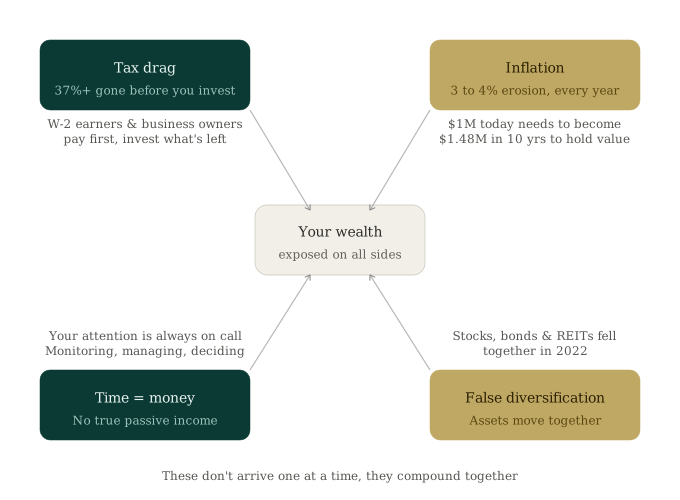
The four forces working against a high earner’s capital
Taxes arrive before your capital does. A high earner is likely losing 37% or more of every additional dollar before it can be deployed. Most strategies help you invest what is left. Very few change the structure of what gets taxed.
Inflation is a constant. A 3 to 4% annual erosion in purchasing power sounds abstract until you work out that $1M in savings today needs to become $1.48M in ten years just to hold its real value. Most fixed-income and cash-equivalent holdings do not come close to clearing that bar.
Your time is still in the equation. Investors who describe themselves as passive are often monitoring positions, rebalancing and managing a rental every week. True passivity is rare, and income that grows without a corresponding demand on your time is rarer still.
And the portfolio is less diversified than it looks. Owning more stocks, bonds and REITs does not change what they respond to.
What passive multifamily investing does differently
When you own a piece of an apartment community, you are not betting on a market. You own a service that people need regardless of what that market does. Rents are tied to local employment and housing demand, not Fed policy or earnings reports.
When inflation rises, so do rents, and so does the replacement cost of the building itself. The asset appreciates in nominal terms precisely because of the forces that erode savings elsewhere. The income side of that equation is strengthening too, which we laid out in our look at why wage growth is an underrated tailwind for apartment owners.
From a tax standpoint, the structure is different in kind. Depreciation, and specifically accelerated depreciation through cost segregation, creates paper losses that can offset real income. For investors who qualify, that can shelter passive income and, in certain cases, active W-2 income as well. This is not a loophole. It is a deliberate feature of the tax code that rewards long-term capital formation in housing, and recent legislation reinforced it, as we explained in our breakdown of what the One Big Beautiful Bill changed for real estate investors.
And in a passive syndication, none of this requires your time. The operator handles acquisition, management, capital improvements and disposition. You participate in the economics without participating in operations.
When a passive multifamily allocation is the wrong move
Be honest about the trade-offs. A syndication is illiquid: your money is committed for a multi-year business plan, and there is no exchange to sell on if you change your mind. Distributions depend on property performance and are never guaranteed. If you will need this capital back within a few years, or you cannot tolerate uneven quarterly cash flow, this is the wrong vehicle.
Timing matters as well. Real estate runs in cycles, and buying near a peak can hand back years of gains. Before committing, read how the four phases of a real estate cycle show up in rent and pricing data so you can place today’s entry point honestly.
Passive also does not mean no diligence. You are outsourcing operations, not judgment, and the biggest decision you make is which operator you back. Most offerings are limited to accredited or sophisticated investors.
What most coverage of passive multifamily investing misses
Generic articles stop at “real estate diversifies.” The structural advantage only exists if the return driver is operational rather than macro. A property whose business plan depends on cap rates compressing is just another rate bet, and you already own plenty of those.
That is why we underwrite the way we do. We buy Class C- to B+ communities built after 1975, 50 or more units, priced $4M to $50M, in markets chosen for demographic and economic growth while avoiding oversupplied submarkets. We require occupancy above 80% unless there is clear renovation upside, and business plans target up to 10% cash-on-cash. Our value-add thesis is that most underperformance traces to mismanagement, poor supervision and high vacancy, problems an operator can fix on site rather than problems you hope the market fixes for you. It is the same reasoning behind our case for where capital is moving in the mid-tier apartment segment in 2026.
The record so far: 28 communities (20 active, 8 realized), 13 deals taken full cycle, and 95% average occupancy across Texas, Arizona, Florida, Georgia, the Carolinas and beyond. Past results do not promise future ones, but they show what an operational thesis looks like when executed. The full sourcing and underwriting process is on our investment strategy page.
Passive has to be truly passive on your side, so reporting is part of the structure. Investors receive a Quarterly Property Report roughly 45 days after each quarter closes, distributions are evaluated on the same timeline, and each investor receives a K-1. Investing through an IRA or an entity is possible, and investors are welcome to visit the properties.
What to check before you commit
Test the argument against your own numbers. Four checks cover most of it:
- Your marginal rate. If it is 37% or higher, the tax structure of your next dollar matters more than the return on it.
- Your inflation math. Apply 3 to 4% a year to your cash and fixed-income balances and ask whether they can outrun it.
- Your hours. Count the time your “passive” holdings actually take each month.
- The operator’s track record. Ask for full-cycle deal count, average occupancy, reporting cadence and target property criteria in writing.
Then watch the entry conditions. The reset in valuations from the 2022 to 2023 rate cycle, combined with persistent rental demand driven by the housing shortage, has produced entry conditions that have not existed for several years. Whether they last is the thing to monitor. The mechanics (accreditation, K-1s, IRAs, distributions) are covered on our investor FAQ, or you can book a call with our team.
Questions investors ask about passive multifamily investing
Is passive multifamily investing right for me if I already own a rental property?
Often, yes. A rental gives you the tax treatment but also the tenants, repairs and vacancy risk of a single unit. A syndication spreads that across a community of 50 or more units with professional management and takes the operations off your calendar. The trade is control and liquidity for scale and time.
How much of my time does a syndication actually take?
After your initial diligence on the operator and the offering, very little. You review a quarterly report, receive any distributions the property supports, and file the K-1. You do not choose contractors, approve leases or field tenant calls.
What are the main risks?
Illiquidity, operator execution and local market conditions. Your capital is committed for the length of the business plan, returns depend on the operator fixing what they said they would fix, and rents can soften in an oversupplied submarket. Distributions are never guaranteed, and it is possible to lose principal.
Related reading
- Why market cycles matter for multifamily investors, the timing side of the structure argument.
- The case for mid-tier multifamily in 2026, where the operational thesis is playing out now.
- How the Big Beautiful Bill changes real estate tax benefits, the depreciation rules behind the tax advantage.
Invest alongside us.
Talk with our team about the current offering, how distributions work, and whether a private multifamily allocation fits your plan.
Open to accredited and sophisticated investors. Investing involves risk, including loss of principal.