Multifamily Demand Rises as Housing Constraints Sideline Buyers
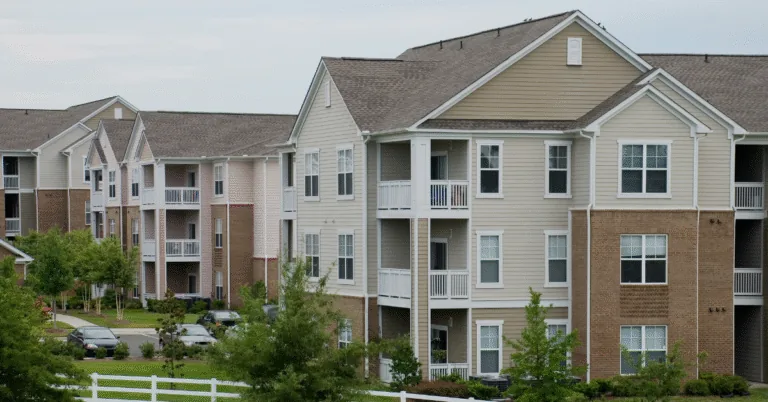
Multifamily demand is rising because a large share of would-be homebuyers cannot make the purchase math work, so they keep renting. With the 30-year fixed mortgage rate at 6.58% even after easing, and the country still short an estimated 2 million homes, apartments are absorbing households that a decade ago would have bought.
The numbers behind that statement are unusually clear. In Q2 2025 net absorption rose 47% year over year, the strongest second quarter in over three decades, and vacancy fell to 4.1% despite a heavy construction pipeline. Below we lay out what is driving the demand, where it does not translate into a good investment, and how we underwrite around it.
Why single-family affordability is feeding multifamily demand
Homeownership is still the goal for most households. The barrier is the monthly payment, not the desire. Mortgage rates have eased to 6.58% on a 30-year fixed loan, which helps at the margin, but the combination of rate and price has kept many middle-income households out of the buyer pool.
The sales data shows it. Single-family home sales declined 2.7% in June, according to the National Association of Realtors, even as inventories reached 20-year highs. The median new home price fell 6.2%, and buyers still did not step in at scale. Rising inventory, falling prices and lower sales together describe a market where the buyer, not the supply, is the constraint.
Households that cannot buy do not disappear. They rent. We wrote about that handoff in more detail when builder sentiment stalled and hesitant homebuyers became multifamily's steadiest tenants. The point for investors is simple: every quarter the purchase math stays broken, the renter pool grows.
What absorption, vacancy and rent growth are telling us
The apartment sector has responded with the strongest leasing in a generation. Net absorption in Q2 2025 rose 47% year over year, the best second-quarter figure in more than three decades. Vacancy declined to 4.1%, well below long-term averages, even with heavy deliveries still hitting the market.
Rents followed. Effective rents are rising again, with June registering the fastest annual increase since mid-2023. That is what you would expect when new supply is being leased faster than it is completing.
Two forces sit underneath these figures. The cyclical one is single-family affordability, which pushes households toward rentals when rates and prices are high. The structural one is the national shortage: the U.S. remains short an estimated 2 million homes, with unmet demand concentrated in growth markets across the Sun Belt, Southwest and Midwest. Our look at the record number of renter households and what it means for apartment owners covers the structural side in depth.
When strong multifamily demand still makes a bad investment
Demand at the national level does not protect a specific property. Heavy construction pipelines in certain metros are likely to put short-term pressure on vacancy and temper rent growth. Forecasts for 2025 call for national rent growth of 2.2%, slightly below the historical average, while the new supply is absorbed. A deal underwritten to aggressive rent growth in a metro with a full delivery schedule is a bad deal regardless of how good the national headline looks.
Timing matters too. Transaction volume is expected to rebound moderately in 2025, reaching $370 to $380 billion, driven by loan maturities that require refinancing, sidelined capital coming back, and prices that have stopped falling. That is a better entry window than two years ago, but it also means the easy discounts are fading. Investors who wait for a perfect signal tend to buy after the spread has closed.
Here is where we would tell someone not to invest: if the business plan depends on rent growth rather than operations, if the sponsor cannot explain the submarket's delivery schedule, or if you need the capital back inside a few years. Private multifamily is illiquid and returns are never guaranteed. Location choice also matters more than the demand story suggests. Suburban submarkets with limited new supply have held up better than urban cores through this cycle, a pattern we examined in our piece on why suburban apartments have quietly outperformed.
What most coverage of multifamily demand misses
Most articles stop at "people cannot buy, so they rent, so buy apartments." That skips the part that actually determines returns: the difference between a submarket with demand and a property that captures it. In our experience, most underperformance in multifamily traces to mismanagement, poor supervision and high vacancy, not to a lack of renters. Demand is the tailwind. Operations are the engine.
That is why our criteria are narrow. We target Class C- to B+ communities built after 1975, with 50 or more units, priced between $4M and $50M, in markets chosen for demographic and economic growth. We avoid oversupplied submarkets on purpose, because a heavy delivery schedule can neutralize a strong regional demand story for two or three years. We look for occupancy above 80% at acquisition unless there is clear renovation upside, and our business plans target up to 10% cash-on-cash, which is a target and not a promise.
The portfolio reflects that discipline. Across 28 communities, 20 active and 8 realized, we have averaged 95% occupancy, with concentrations in Texas markets such as Dallas (McCallum, 419 units; Villas de Zocalo, 437 units), San Antonio (Culebra, 327 units) and Houston (Oasis, 144 units). Those are the growth metros where the housing shortage bites hardest, and where a well-run community from our target vintage competes directly for the household that just got priced out of a starter home. You can see how we source and underwrite on our investment strategy page and the full list of communities on the portfolio page.
What to watch next
For a skeptical reader, these are the figures to track. If absorption stays high while deliveries fall, the 4.1% vacancy figure should hold or tighten. If the 2.2% rent growth forecast for 2025 gets revised upward as supply is absorbed, the cycle is turning in owners' favor. The expectation has been that new construction moderates in 2026 and beyond, and that is the single biggest swing factor for rent growth.
Watch policy as well. Housing legislation moving through Washington could change both the demand and the supply side of this equation over a multi-year horizon. We laid out our read of that in a note on what the ROAD to Housing Act could mean for apartment owners.
Finally, watch the single-family side. If mortgage rates fall far enough to reopen the purchase market for middle-income households, some renter demand will migrate back to ownership. We do not expect that to close the 2 million home gap, but it would shift the cyclical part of the story.
Questions investors ask about multifamily demand
Is multifamily demand strong enough to offset new supply?
At the national level, yes for now: absorption rose 47% year over year in Q2 2025 and vacancy fell to 4.1% while deliveries remained high. At the submarket level it depends entirely on the local pipeline. We underwrite the specific submarket's delivery schedule rather than the national figure.
What happens to apartment demand if mortgage rates drop?
Some households would move from renting to buying, and that would soften the cyclical part of the demand story. The structural shortage of an estimated 2 million homes does not go away with lower rates. We build business plans that work on operations, not on rates staying high.
Is private multifamily right for me?
It fits investors who can leave capital in place for several years, want quarterly income that is evaluated after each quarter and never guaranteed, and prefer owning real property to trading paper. It does not fit anyone who needs liquidity on short notice. Our offerings are open to accredited and sophisticated investors, and the fastest way to find out if it fits your plan is to book a call with our team.
Related reading
- Why a record count of renter households matters for apartment owners, the structural side of the demand story in one place.
- Suburban apartments as a quiet outperformer, where the demand described here has held up best.
- The ROAD to Housing Act and multifamily investors, the policy variable that could reshape supply.
Invest alongside us.
Talk with our team about the current offering, how distributions work, and whether a private multifamily allocation fits your plan.
Open to accredited and sophisticated investors. Investing involves risk, including loss of principal.